How to boost support with your charity donation thank you email

Are you sending thank you emails to your donors? When do they go out? What information do you put in them? Are they warm and friendly or formal in tone?
Every decision you make regarding your charity donation thank you email has an impact. This article will help you make a positive impression on your donors, boosting the likelihood of further support.
8 tips to optimise your charity donation thank you email
Use personalisation
According to Dynamic Yield, personalisation has an influence on email open rates, with 71% of us affected. Fortunately, all the top email marketing service and customer relationship management (CRM) providers offer personalisation as standard. Instead of adding a generic ‘Dear Sir/Madam’ at the top of your emails, you can insert a tag which pulls the donor’s name from your mailing list. If you’ve ever used ‘mail merge’ when printing out letters, it works in the same way.
Depending on the services you use, you may be able to personalise your thank you emails in other ways. For example, Campaign Monitor found that using personalisation in the email’s subject line increased open rates by 26%.
Link the donor’s generosity to the work you do
Just because someone has made the decision to donate, it doesn’t mean they understand exactly what you do. Your thank you email is the ideal opportunity to remind them by linking your supporter’s donation with the impact of your work. Include specific details where possible (names, places, figures, etc.) because this will make that relationship more personal.
Placing the focus on the donor rather than your organisation is a powerful way to strengthen their connection with your cause. For example, you could write:
‘Thanks to your donation, (recipient x) will receive (benefit y)’
Include a call-to-action (CTA)
Every point of contact with your donor is an opportunity to increase their value to your charity. For example, you could ask a donor who has made a one-off donation to consider making a regular gift, placing a button that links to the relevant page on your website.
Another option is asking your donor to share your campaign via social media or fill out a donor survey.
Be warm – but concise
The best thank you emails strike a balance between brevity and warmth. An effective strategy is to write freely, prioritising a warm tone and expressing your gratitude. Then go back and remove any words that don’t add anything new to the message.
If you are struggling, consider asking a copywriter to help craft your thank you emails.
Make the most of automation and segmentation
If your email marketing or CRM service offers list segmentation and/or email automation, use these features.
With segmentation, you could separate new donors, single donors and repeat donors into separate lists. Each donor would receive an email tailored to their segment. You could even single out those donors who have made large gifts and send them a handwritten thank you letter.
Automation enables you to set a donation as a trigger for a series of emails. For example, you could send an immediate thank you email followed by a donation receipt. Two days later, you could send the donor a request to share your campaign, and a week after that, a survey.
Don’t delay!
You should send your charity donation thank you email immediately. There is no value in delaying it. Even if you want to show your donor appreciation by sending out a beautiful handwritten card, make sure you send them a thank you email first.
Pack a punch with your subject line
You want your thank you email to stand out in your donor’s inbox. Thanking the donor by name is likely to draw their attention. Follow this up with a short and punchy sentence (e.g. You’ve made a huge difference today).
Say it with pictures
You don’t want your thank you email to be too wordy, so consider adding a picture or two for added impact. Some charities embed videos in their thank you emails, but this may cause issues with some donor’s devices.
Charity donation thank you emails: some examples
During our research, we made some small donations to leading UK charities so that we could assess their thank you emails.
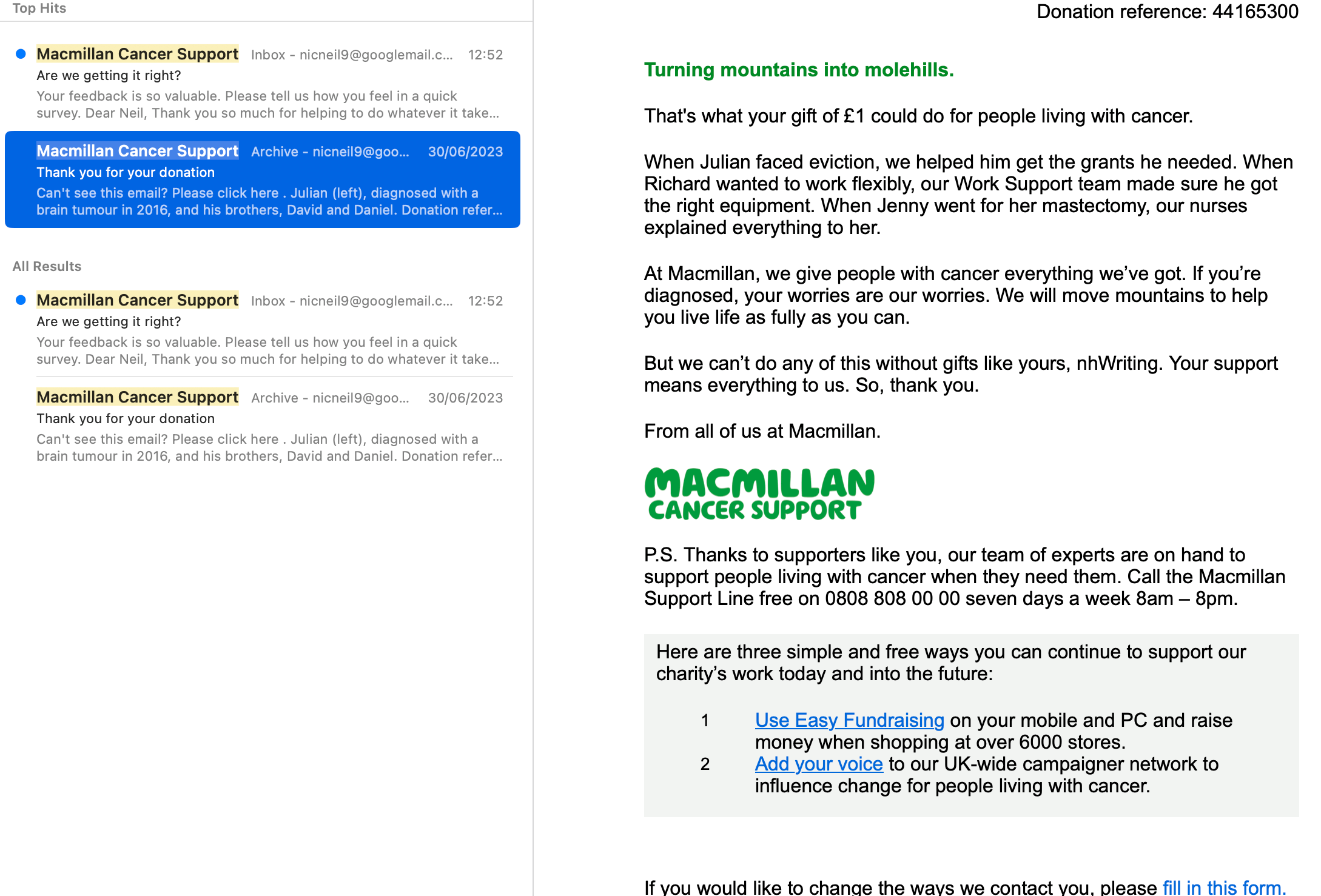
All three charities followed good practice by sending their emails the same day as they received the donation. All three made use of personalisation, but while the Cancer Research UK (CRUK) and the British Heart Foundation (BHF) put the donor name prominently in the email header, Macmillan only used it in the email body.

The three charities also linked our donations to the work they do. Top marks for the BHF for mentioning 3D printed hearts. Who could resist clicking that link for more information? CRUK made a powerful impact with their smart use of imagery, while Macmillan used an effective case study to draw our attention.

All of the charities also placed CTAs prominently in their emails. CRUK chose a case study link and social share icons, Macmillan promoted Easyfundraising and Campaigner Network as ways to provide further support, and BHF opted for contact details and social share icons.
Finally, BHF and Macmillan followed up their initial email with further emails. BHF sent a confirmation receipt a minute after their thank you email which was confusing because we read the receipt first. The receipt was brief and formal, and could easily have been mistaken for a badly written thank you email.
Macmillan sent a survey invite six days after our donation. This included an attractive footer with social share buttons.
In the words of Wild Apricot, once you’ve received a donation, you enter the ‘stewardship phase‘ of that donor relationship. A timely, warm and well-structured charity donation thank you email will make your donor feel appreciated and inclined to continue their support.
How do you make an impact with your thank you emails? Do you have any advice to share with our readers?
Related Articles
You may also be interested in these similar articles.